Faith the Foundation
“Brethren, knowing that it is now the hour for us to rise from sleep. For now our salvation is nearer than when we believed. The night is passed and the day is at hand. Let us therefore cast off the works of darkness, and put on the armor of light.”
-Romans 13:11
Excerpt from the Epistle of the First Sunday of Advent
Dear Friends of Carmel,
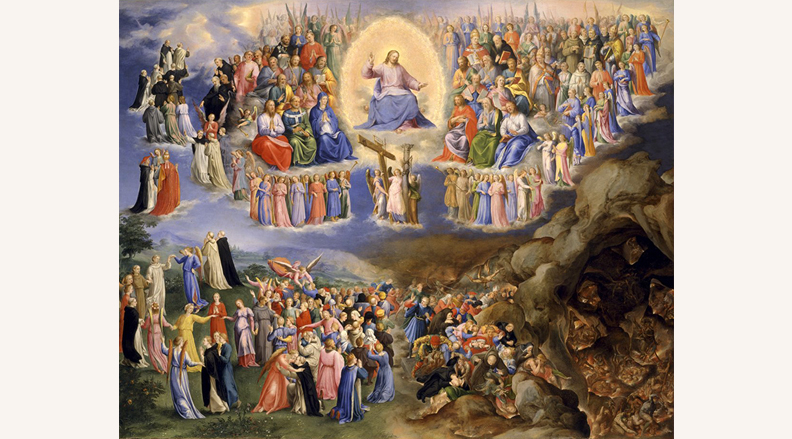
The Liturgical Year draws to a close. Nature has divested itself of summer glory, and the bleak, bare branches, cold crisp air, and short days are a reminder to us of the lessons that Holy Church puts before our eyes these last weeks of the year. Since November 2nd and throughout this month, we pray earnestly for the Holy Souls in Purgatory. The Church directs thoughts and prayers towards our own death and judgement. In the coming weeks, the Advent Liturgy will focus yet more pressingly on that theme, urging us to ask the soul-searching question: – Are we ready?
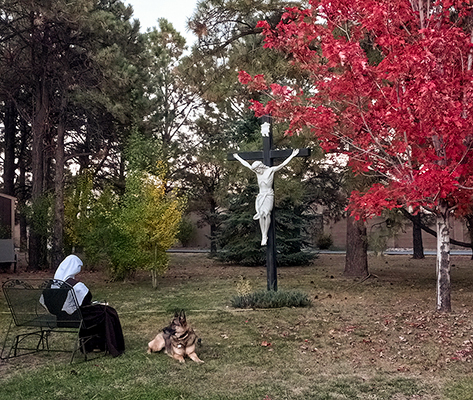
“When the Son of Man comes, will He find, do you think, faith upon the earth?” This question Our Lord put to the Apostles is a devastating one. He implies in the asking that indeed no, He will not find faith upon the earth when He comes to judge it. “Faith” is a word that has many meanings, many different understandings and interpretations. Alas, many do not understand faith in the way that Our Lord spoke of it.
Keeping in mind that “Faith comes from hearing (Rom. 10:17),” we offer a recorded excerpt from a conference given some years ago on the topic of Prayer. In it, Father defines Faith – the Theological virtue of Faith – and describes how it is misunderstood, how to practice and live it, and how it unites us to God along with Hope and Charity (1 Cor. 13).
Our Catechism defines faith as follows: “Faith is the virtue by which we firmly believe all the truths that God has revealed, on the word of God revealing them, Who can neither deceive nor be deceived.” Immediately we can see the difference between the supernatural faith of the virtue and the natural faith often confused with it. Faith is a divine power (virtue), the will’s embrace of God’s testimony. Man’s reasoning does not obtain faith. We do not believe the truths of the Faith because they make sense, but simply because God has revealed them.
One example from the Gospel of the contrast between supernatural faith and faith that is of nature comes from the sixth chapter of St. John’s Gospel (6:26-72), where Our Lord explicitly laid out His plan for the Holy Eucharist.
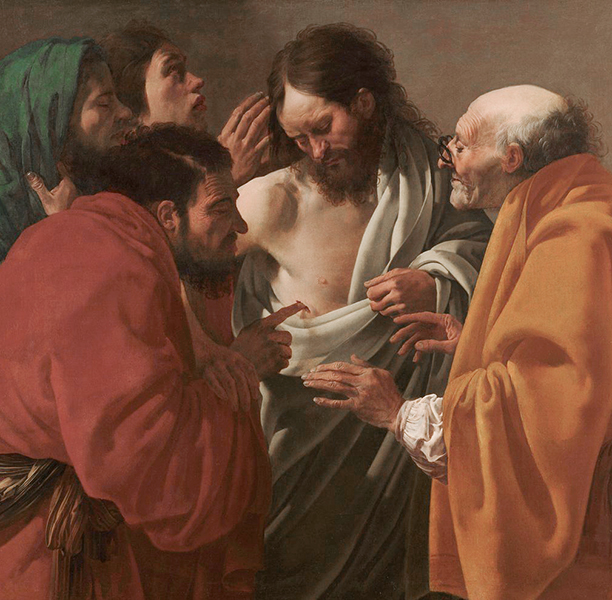
“Blessed are they who have not seen, and yet have believed” (John 20:29).
“The bread that I will give is my flesh for the life of the world….My flesh is food indeed, and my blood is drink indeed. He who eats my flesh, and drinks my blood, abides in me, and I in him.” These words would be a dividing line, a “sign of contradiction” – and would remain so through the centuries. Those who then heard them, including the Apostles, certainly had no understanding of what Jesus was saying. They knew nothing of the mystery of Transubstantiation.
They had not the benefit of St. Thomas Aquinas’ great insight, nor the knowledge of countless theologians and mystics through the centuries to explain the reality and fulfillment of these words. Neither could they foresee the Mass, which would be the perpetual sacrifice of the Church, nor the “Living Bread” that would be spiritual nourishment of souls until the end of time. Some listened with patience and loyalty, despite the incomprehension.
But others who heard Christ’s words reacted in a purely natural manner, quarreling among themselves: “How can this man give us his flesh to eat? … This is a hard saying. Who can listen to it?” Jesus, standing His ground and retracting nothing, responded by reproving their lack of faith. “Does this scandalize you?… The words that I have spoken to you are spirit and life. But there are some among you who do not believe… this is why I have said to you, no one can come to Me unless he is enabled to do so by my Father.”
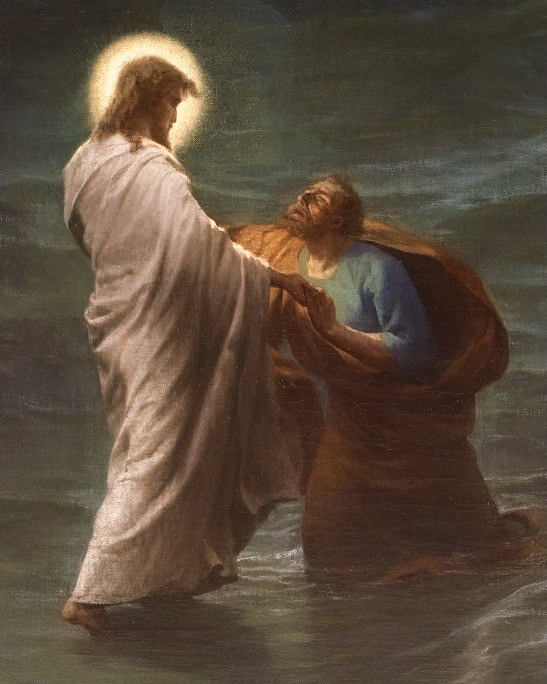
“O you of little Faith, why didst thou doubt?” (Matthew 14:31).
No one can make an act of supernatural faith without God’s help. This is what Our Lord is referring to. Many left Him. But He turned to His disciples and said “Do you also wish to go away?” Here St. Peter answers for the entire Church with an act of supernatural Faith, assenting to things unseen, not understood, but in a movement of grace, simply on Christ’s word: “Lord to whom shall we go? Thou hast words of everlasting life, and we have come to believe and to know that thou art the Son of God.” We, as Catholics, do not wait to understand in order to believe; rather, we believe the word of God, that we may gain by His grace and light, understanding of it when and in the way He wills. From this profession of St. Peter’s faith, handed down to all believers, the Church received the power to confect the Eucharist, the life and soul of the Church, the Body of Christ Himself, present with us through the ages. It is a dogma, believed with supernatural faith, which makes the Catholic religion a sign of contradiction to the other religions of this world.
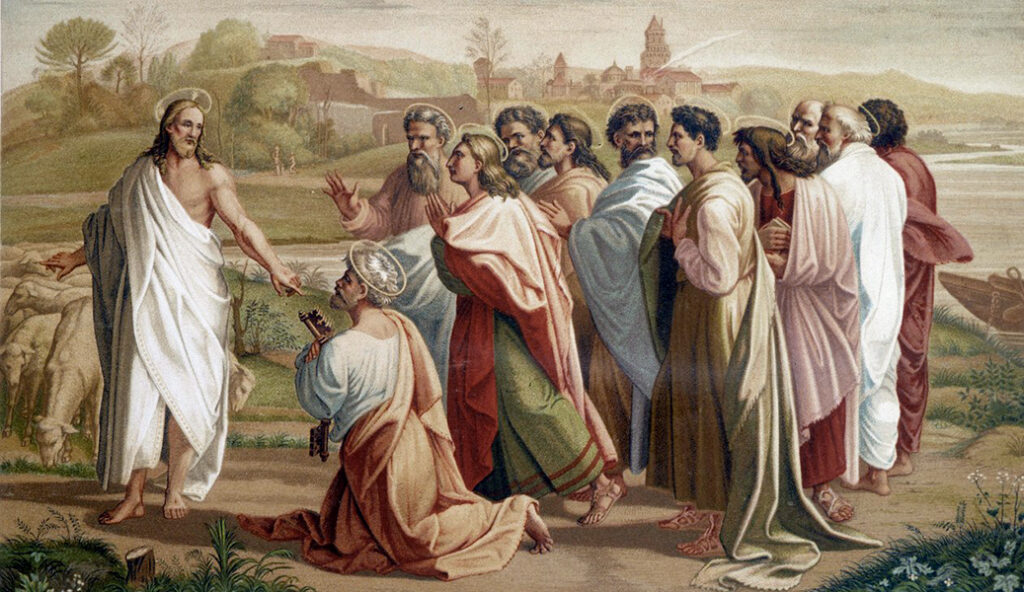
“Thou art the Christ, the Son of the living God.” Then Jesus answered and said, “Blessed art thou, Simon Bar-Jona, for flesh and blood has not revealed this to thee, but my Father in heaven. And I say to thee, thou art Peter, and upon this rock I will build my Church, and the gates of hell will not prevail against it” (Matthew 16:16).
The Catechism goes on to list the qualities of supernatural faith. It must be steadfast: “To be deliberately doubtful on matters of faith is equivalent to denying outright God’s authority.” Alas, how often today do many approach matters of faith as “matters to be debated!” Second, it must be complete: “To accept one truth and deny another is equivalent to denying all the truths He has revealed.” Once again, it is the lamentable truth that many in the Church are “cafeteria Catholics,” approaching their faith the way non-Catholics do, picking and choosing which truths they wish to adhere to, and which they wish to dismiss. Is this true and supernatural faith?
“Without faith it is impossible to please God (Heb. 11:6),” but it is also impossible to be saved! But faith is just the beginning of salvation. If our faith does not lead us to charity, to love of God, then it is a dead faith. If it does not show in our daily actions, then as St. Paul says, we “have believed to no avail.” St. James in his Epistle (2:14-26) asserts, “I from my works will show you my faith,” and goes on to conclude to teach that “faith without works is dead,” giving examples of those whose love for God and neighbor – charity – justified them in God’s sight.
“Faith is not just ordinary knowledge – cold, theoretical, and abstract; it is a cleaving to God who is primordial Truth and the fullness of perfection. It is a cleaving of the mind, enlightened by a supernatural light and directed to its object by an effective movement of the will….
….the insight of faith immediately sets Christian hope in motion. Knowledge of Christ the Redeemer fills the soul with a vast trust in the sanctifying power of His mysteries, for the mysteries of Jesus are the sacraments of life. If we assiduously contemplate His sacred humanity, we shall cleave to its divine wounds and its holy operations with the ardent desire to draw from the treasures of grace that they hold for us…
…But the love that impels the soul to Jesus, the love for this God-man, our Model, is an active love, a transforming love, a love that makes us reproduce within ourselves the traits of the divine Exemplar. The soul that has contemplated Jesus with a lively faith and has attached itself with unlimited trust to His sacred humanity is naturally impelled to imitate Jesus in its whole life, to accomplish its every act with Jesus and in Jesus, to consummate a union of life and action with Jesus.”
-In Him is Life, Ernest Mura
If our Faith were strong, if it permeated every fiber of our being, if we were as convinced as we should be of the divine realities that we touch every day – would our lives be different? Our Lady of Fatima told the three children, “If men only knew what eternity is, they would do everything in their power to change their lives.” As Father explains in the sermon we provided, faith in the eternal God and His eternal Word is the foundation – and to hope and to love, the essence of Divine Union – the three theological virtues. “These three,” said St. Paul, “but the greatest of these is charity.”
“Do you think when the Son of Man comes, He will find Faith upon the earth?” (Is He not also asking, “Will I find hope, will I find love?”) When we read or hear again those sad, lonely words of the Savior, how do we answer? Are we ready for that day of His Coming? Do we have that pure, untainted Faith that always puts God first in and above all things of our life?
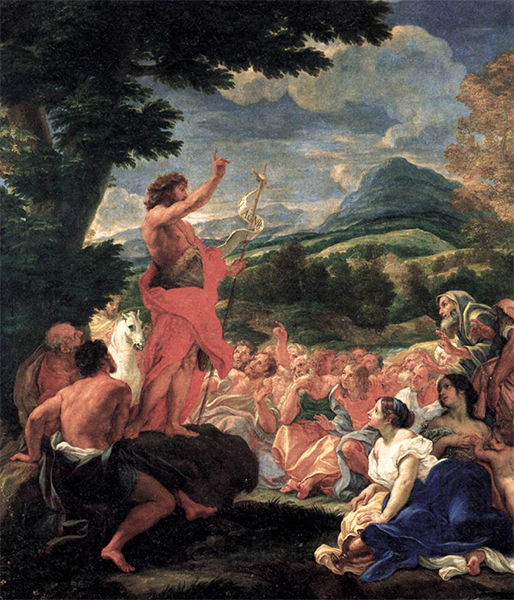
“Repent, for the kingdom of heaven is at hand…Make ready the way of the Lord, make straight his paths;” (Mathew 3:2).
If in such an examination of conscience gives us even a little fear that we fall short of what God has a right to expect of us, that is a healthy, good fear. If we dread the day of personal judgment, as well as that which must come upon a world calling out for it in its blatant disregard of God and His laws, let us, with faith, hope and great love, lift up our hearts. Our Holy Mother the Church gives us Advent, the liturgical season of holy hope.
During these weeks of preparation, as we read the Christmas prophecies for the coming of the Redeemer, let us make the prayer a personal one. For those whose hearts call out to Him, He will come anew at Christmas. Let us pray especially for an increase of the virtue of faith, for our own souls, for the souls of those we love, and for the world. Our loving God will give this gift of Christmas light to shine bright into every dark corner.
May the graces of these days come in abundance to assist you. “May the God of hope fill you with all joy and peace in believing (Rom. 15:13)…”
In Christ,
Your Carmelite Sisters
* Website News *
Advent Candles and Calendars
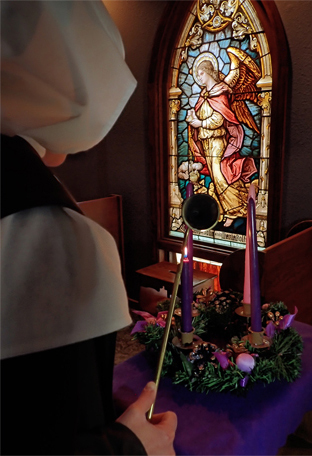
With the season of Advent just around the corner, time is running out to order your Advent candles and have them in time, especially if you want to have them blessed. If you are unfamiliar with the custom of the Advent wreath, you can read more about this cherished family tradition on our website.
We also have many new styles of Advent calendars to choose from. It is a wonderful and enjoyable way for children to count the days leading up to Christmas. These calendars have small pictures and bible verses to help draw attention to the meaning of the season and preparation for Our Lord’s birth.
The Twelve Days of Christmas
Few people say that the “Twelve Days of Christmas” is their favorite Christmas carol. Obviously, it is repetitive, and it’s rather long and tedious, a ditty with little melody or art. It is a list, sung over and over – backwards, of nothing but seemingly odd, mostly impractical items that are supposed to be Christmas presents for a loved one. Not much substance on which to reflect or even bother a second thought. At least at first glance. Or is this tune and its mysterious lyrics, sung at Christmas time with such jolly good cheer, something more – something else altogether?
Have you ever heard of the Penal Laws?
The Catholic Encyclopedia tells us: By a series of statutes, successive sovereigns and Parliaments from Elizabeth to George III (1558-1791), sought to prevent the practice of the Catholic Faith in England (and other English-speaking countries). To the sanguinary laws passed by Elizabeth, further measures, sometimes inflicting new disqualifications and penalties, sometimes reiterating previous enactments, were added until this persecuting legislation made its effects felt in every department of human life. Catholics lost not only freedom of worship, but civil rights as well; their estates, property, and sometimes even their lives were at the mercy of any informer. The fact that these laws were passed as political occasion deprived them of any coherence or consistency; nor was any codification ever attempted, so that the task of summing up this long and complicated course of legislation is a difficult one.
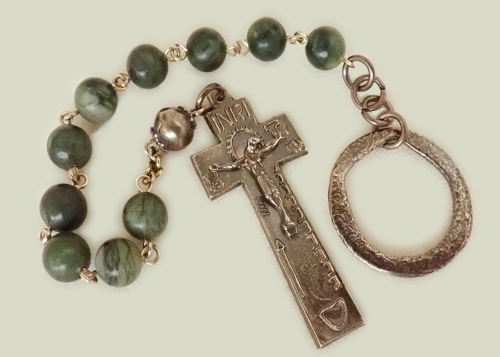
The Irish penal rosary comes from this period in Catholic history. The penal rosary was a small rosary, easily hidden in a pocket or up a sleeve. The large ring was put on the thumb while the first decade was said, and the ring was moved from finger to finger as one prayed through the 5-decades of the rosary. The penal crucifix often seen on rosaries of this type originated from this time and was full of Catholic symbols for those who knew what they meant, such as the jug in Our Lord’s right hand, was meant to represent the chalice at the Last Supper, showing the union between the sacrifice of Christ on the Cross and the Sacrifice of the Mass.
During the late 1600s and through a good part of the 18th century, the Catholic Irish and English suffered under these Penal Laws. The Catholic Church was an “underground Church,” a hidden Church, and to profess one’s faith publicly carried heavy penalties, the death penalty in some cases. One way the Irish preserved and practiced the Faith openly was through encoded songs. To the casual listener, they were harmless love songs, but to those who knew their deep spiritual meanings and symbolisms, they were professions of the Faith, prayers for the liberation of Ireland, and even one of the means of continuing to teach the Catechism to children.
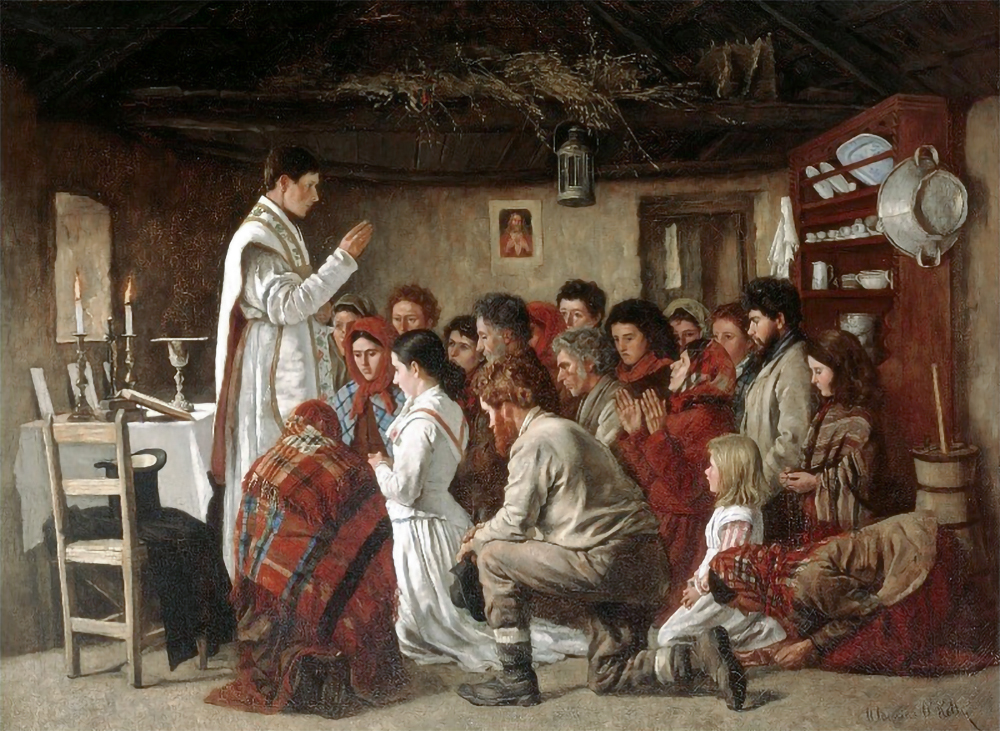
The story is that the “Twelve Days of Christmas” is one of those songs, but it is a story that has caused a great deal of controversy. Type this story into Google and you will be met with an onslaught of “there is no historical proof” messages. Our purpose here is not to prove it categorically by listing the doubts and the historical references that might answer them. We merely make the observation, that we are not at all surprised that such a story would be met with disbelief by our atheistic and doubting world. This is the same world, that in the coming weeks leading up to one of the greatest Feasts of the year, will produce an onslaught of “there is no historical proof” messages – not only about the history of some hymn, but about every aspect of the Christmas story. These messages even go so far as to touch the very dogmas of Christmas itself: the Incarnation, the Virgin Birth, etc.
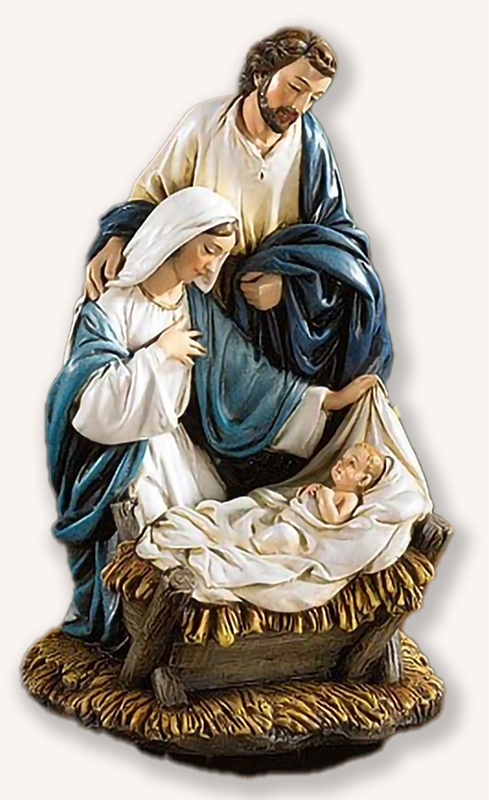
We might not be suffering under laws as strict or obvious as those of the English and the Irish, but we Catholics of today, too, suffer a persecution – a more insidious one. For rather than ban Christmas outright, our world does its best to turn a completely ignorant and blind eye to it. To trivialize it. To commercialize it. To distort it. The modern world does its best to allow us to keep Christmas, all the while taking “Christ” out of it. Christmas is all about giving, generosity and family. “Christmas Spirit” is about joyful togetherness. But it is better to say “Happy Holidays” rather than “Merry Christmas.” Public Nativity sets are increasingly banned, or at the very least under scrutiny and sometimes quite vehement criticism, especially on public government property and in schools.
Trace any of our Christmas customs, from the trees, to the lights, the gift-giving and Santa Claus, to the food and the music, and you will find deep Catholic roots with connections to the Faith and Birth of Christ. Perhaps they have been distorted over the years, and perhaps the true meaning has been forgotten. But that is our fight in the troubled world in which we live. Living in a world that has all but lost the Faith, Christmas is the time, perhaps more than any other, for holding onto that Faith.
It is with that purpose that we present for your edification, the Catholic symbolism behind “The Twelve Days of Christmas”. So perhaps if you hear this song in the coming weeks, the first thing that enters your head won’t be: “Oh no, that song,” but instead, you might remember some of these symbols and the doctrines they proclaim, and you’ll find it an occasion to revel in some of the great blessings of our Faith.
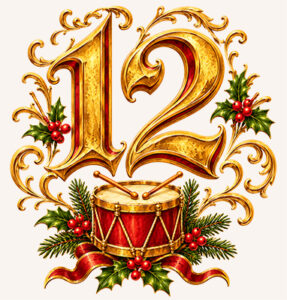
We start, aptly so, with the Twelve Drummers Drumming, a symbol of the twelve points of the Apostles Creed. This summary of our entire faith is the steady, unchanging, drumbeat, the rhythm and direction to which the entire Church militant marches forward in the unity of Faith. Drums have traditionally accompanied soldiers marching into battle, helping them keep together and advance with courage, setting a tempo that rises above all chaos, and all of the other instruments follow its lead.
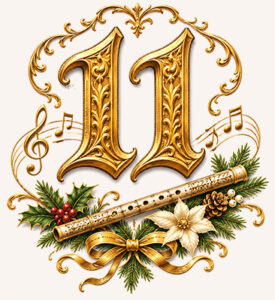
The Eleven Pipers Piping stand for the eleven faithful Apostles. A pipe produces a clear, penetrating sound that carries over a distance. Similarly, the Apostles were sent to announce the teachings of Christ to all nations. Holy Scripture (Psalm 19:4, Romans 10:18) states: “Their sound hath gone forth into all the earth: and their words unto the ends of the whole world.” Although the Apostles were men of different characters, talents and missions, they all proclaimed one and the same Gospel. Just as eleven instruments can play together in harmony, the eleven faithful Apostles were united in the doctrine received from Christ.
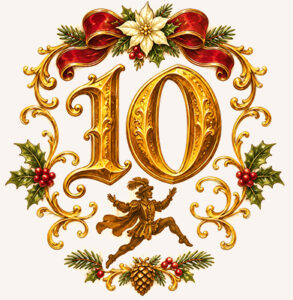
The Ten Lords A-Leaping are the Ten Commandments. In society, lords exercised authority and were responsible to maintain order. The Ten Commandments express the supreme authority of God, the Lord of Heaven and Earth, who alone is the ultimate source of the moral law. The Infant Jesus is the Divine Lawgiver who came not only to teach mankind God’s commandments, but also to give us the grace necessary to observe them. The image of leaping suggests eagerness, energy, and joy. Thus, the leaping lords can suggest the readiness and joy with which a soul should follow God’s commandments, not merely out of obligation, but out of love. The Psalmist declares: “I have run the way of Thy commandments, when Thou didst dilate my heart.” — Psalm 118:32.
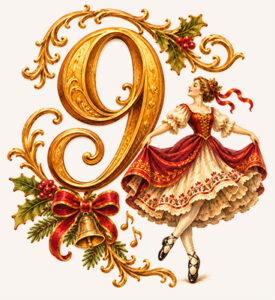
The Nine Ladies Dancing stand for the nine choirs of Angels. Dancing is an expression of happiness, celebration, and rejoicing as well as harmony and perfect order. The Angels rejoice in the glory of God, and their joy was especially manifested at the Birth of Our Lord. The Nine Choirs of Angels exist in a beautiful hierarchy, each fulfilling its appointed role in the Divine Order. Their perfect obedience to God’s will creates a heavenly harmony far surpassing anything on earth.
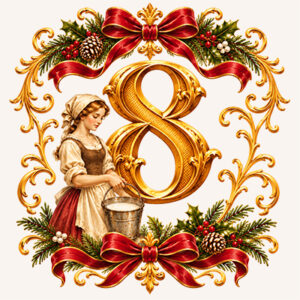
The Eight Maids A-Milking are the eight Beatitudes. The humble domestic chore of milking is symbolic of our labor in the spiritual life. The summit, the goal of that labor in the spiritual life is the Beatitudes, which nourish and sustain the soul as a pure spiritual milk, and draw it into perfect union with God.
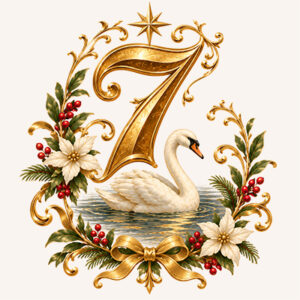
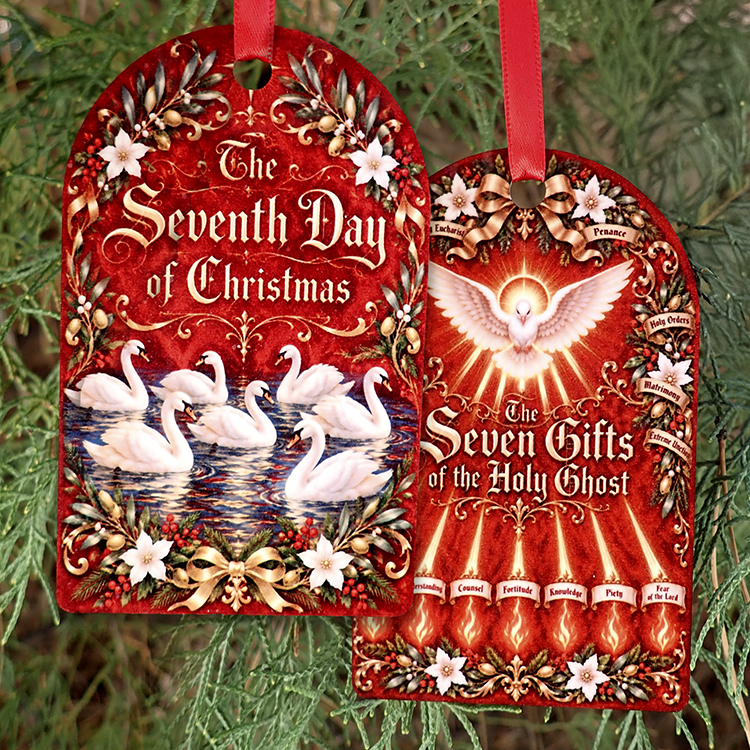
Seven Swans A-Swimming stand for the seven Gifts of the Holy Ghost. The graceful swan is a perfect image of the Gifts of the Holy Ghost, which only reside in a soul that possesses sanctifying grace, a share in God’s life in the soul. The swans are swimming because grace, and therefore the Gifts, is given to the soul in the Sacrament of Baptism, when water is poured on the forehead or immerses the entire body of the new Christian. From Baptism, all the other seven Sacraments flow, as the ordinary means of increasing sanctifying grace in the soul.
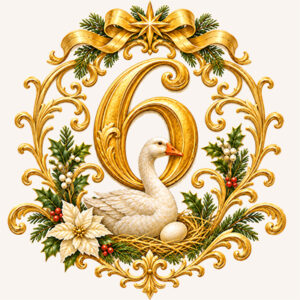
The Six Geese A-Laying are the six days of creation. The egg, in Christian tradition, is a symbol of the beginning of new life (recall decoration of Easter eggs). All creation was summed up in man, and was given as a gift to man in the Garden of Eden. With man’s fall, creation fell under the dominion of Satan. The Christ Child in the manger is not only the Creator of the whole world, but also its Redeemer. He was sent by God the Father to free all creation from the power of the devil and restore man to God’s grace.
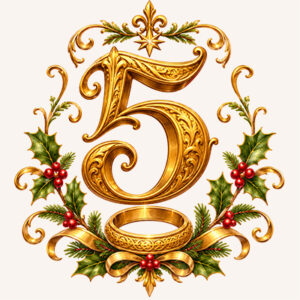
At this point, the entire melody of the song changes to emphasize the great importance of the fifth gift, the most precious of all. The Five Golden Rings are the five Wounds of Christ. Gold, because they are infinitely precious. “Knowing that you were redeemed not with corruptible things, as gold or silver … but with the precious blood of Christ (1 Peter 1:18).” Rings, because the un-ending circular shape of a ring symbolizes eternity. Christ’s sacrifice is eternal with eternal consequences; His sacrificial love is eternal. He bears His wounds, suffered for love of us, even in Heaven.
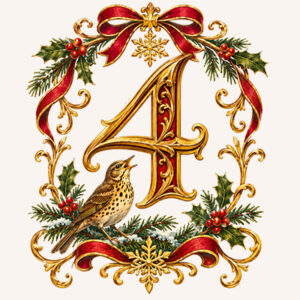
The Four Calling Birds are the four Evangelists, calling out the good news of the Gospel into every corner of the world.
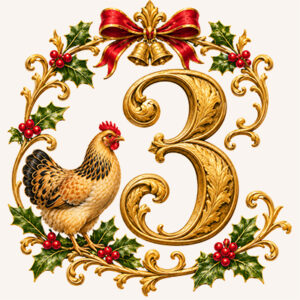
The Three French Hens are the three Theological virtues. French hens were considered a meal fit for royalty, the best to put before a king. The three Theological virtues are the highest of the virtues in that they refer directly to God Himself and have God as their end.
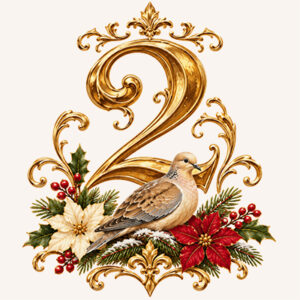
The Two Turtle Doves are the New and Old Testaments of the Bible. As St. Augustine said “The New Testament lies hidden in the Old, and the Old Testament is unveiled in the New,” and the turtle doves, which are said to mate for life, are a symbol of the close union between the two. There is also a connection to the Infancy of Christ and the Presentation in the Temple, the Feast that closes the Christmas season. On this occasion, St. Joseph and the Blessed Mother fulfilled the Old Law by offering two turtle doves in the temple for their Son. Not only did this sacrifice fulfill the requirements Old Law, but it was the first offering of Our Lord to His Father through the hands of a priest, the beginning of the New Law. He came not to destroy the Law, but to fulfill it.
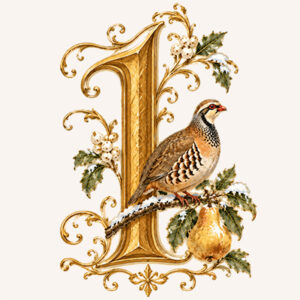
The first gift is the one from which all of the others flow – the Partridge in a Pear Tree is a symbol of none other than Christ on the Cross. According to traditional bird lore, a mother partridge will pretend to be injured to lure a predator away from her young, risking her own life to save them. This is seen as an image of Christ, the Good Shepherd, who lays down His life for His sheep. And of course this bird is found in a tree, a fruit-bearing tree. Just as the Christmas tree in ancient tradition is a symbol of both the tree of life in the Garden of Eden and the Cross on which Our Lord redeemed us, we see a similar symbolism here.
By now, you have probably realized that the “True Love” in the song, giving all of these gifts is none other than God the Father. Who but God loves truly and perfectly? Who is generous as God Himself is generous? Who but God can and would give, so wisely and abundantly, gifts such as these to the souls of men?
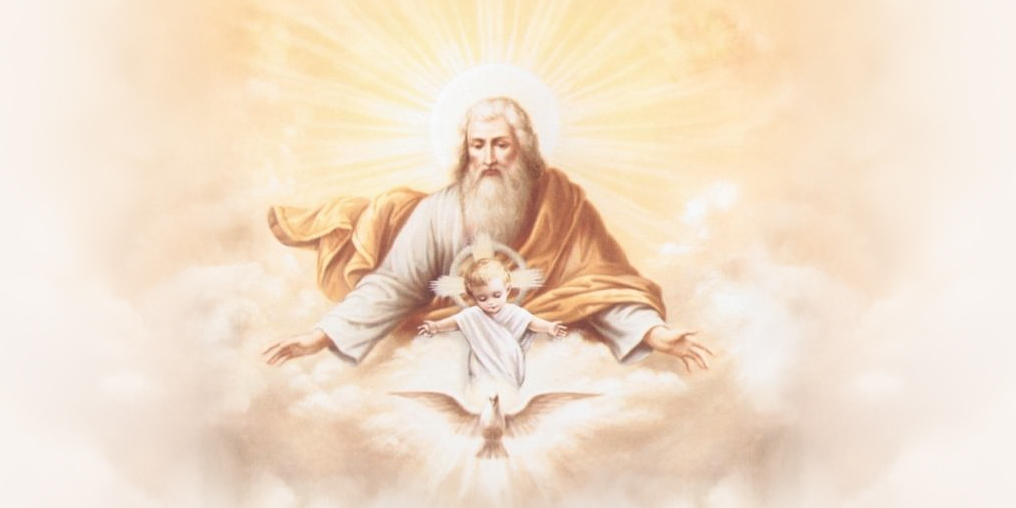
The Twelve Days are the days between the Feast of Christmas and the Feast of Epiphany (January 6th).
Modernity’s celebration of the Feast starts with an invention called “Black Friday” (or even earlier), and ends it with pulling down decorations the day after December 25th. But for Christians, Advent intervenes as a precious time of preparation – and a prayerful preparation at that – along with a little penance. The Vigil of Christmas, with its mysterious and beautiful Midnight Mass, opens the Christmas season, and we spend at least 12 days in celebrating the Gift of a Savior being born to us, reveling in all of the gifts of Redemption. That is most evidently what this song was originally all about.
One more observation about it. Why, O why the repetition?! The slight (or perhaps not so slight for some) annoyance over that repetition might disappear altogether with this one insightful interpretation of just why. The Penal Laws (which, by the way, reached even to the American colonies) took very particular umbrage against the Holy Sacrifice of the Mass. Even today, the Mass is assailed from all sides and grossly misunderstood. But what is the Mass? Very briefly, it is the re-enactment of Our Lord’s sacrifice on Calvary. It is not a new sacrifice, but the same sacrifice renewed: “Do this in memory of Me.”
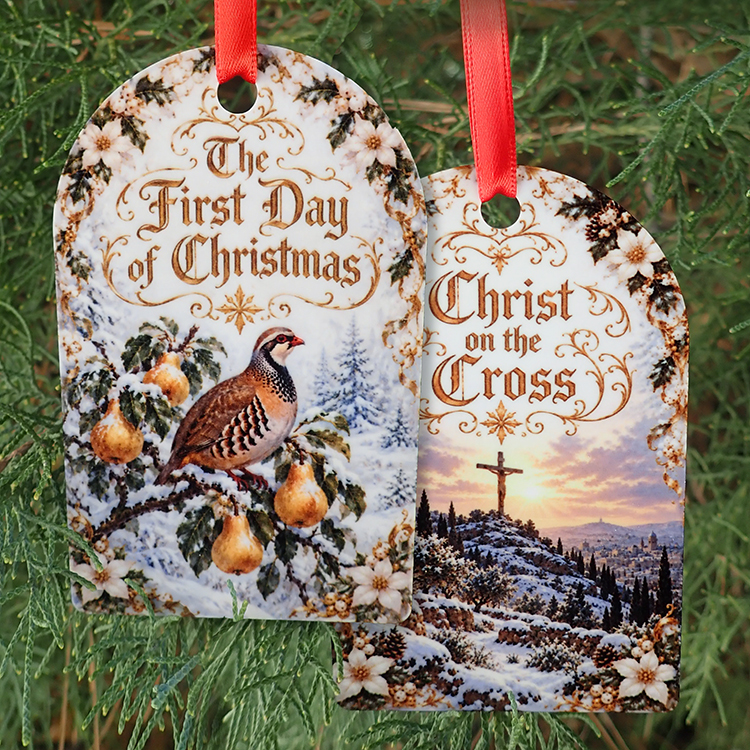
As he did on the Cross, Christ in the Mass makes himself the living bond uniting us to God. We can now appreciate the greatness of all divine worship. And we can see “how the act around which it revolves … and from which it is irradiated, the center from which its whole movement comes and towards which it is ever directed… is the Redemptive Sacrifice itself, present among men in Holy Mass, and at once both eternal and perpetuated in time. In Heaven before God, and on earth among men. The mystery of the consummation of all God’s plans once carried out, yet ceaselessly renewed.
– Quoted in The Holy Mass, Father E. Vandeur
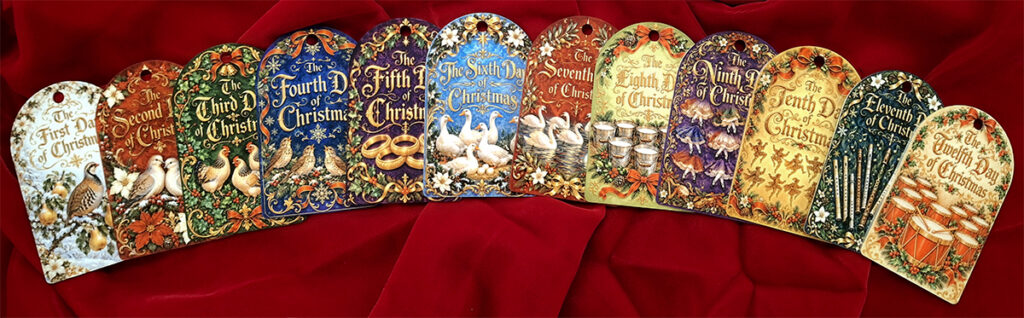
We have fashioned a set of ornaments to keep all the above interpretation of the song alive. Like the “O Antiphon” ornament set we presented in 2025, this might be a new tradition in your homes, businesses, churches, family gatherings: to hang one ornament on the tree for each of the Twelve Days. Or you might choose just to enjoy and reflect on all of them throughout the Christmas season. Either way, for us it is a small way to keep the “drums drumming,” to keep spiritually fighting back against the commercialized Christmas world, and to remind ourselves and anyone else who might see them what the Christmas season is all about.
Other New Christmas Ornaments
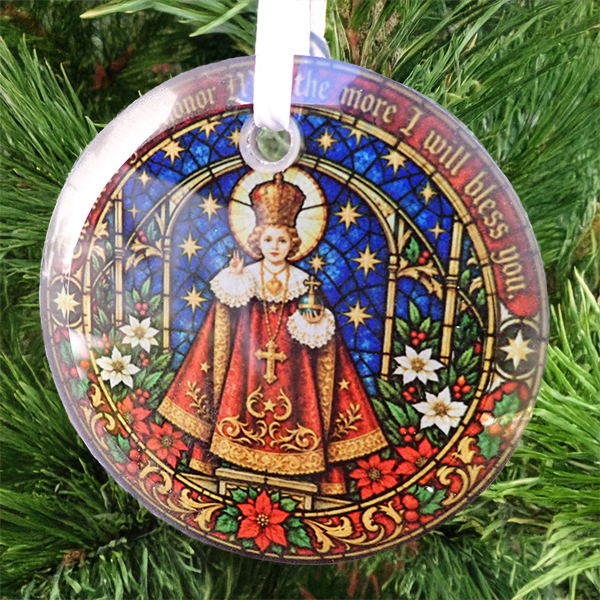
We have a few more “faith centered” ornaments to add to our collection this year. The Infant of Prague is another image that teaches a great deal about the Incarnation in symbol, as we mentioned in a past newsletter. This is the first time we have printed on glass, and we were quite pleased with the results! The ornaments are like little stained-glass windows on the tree.
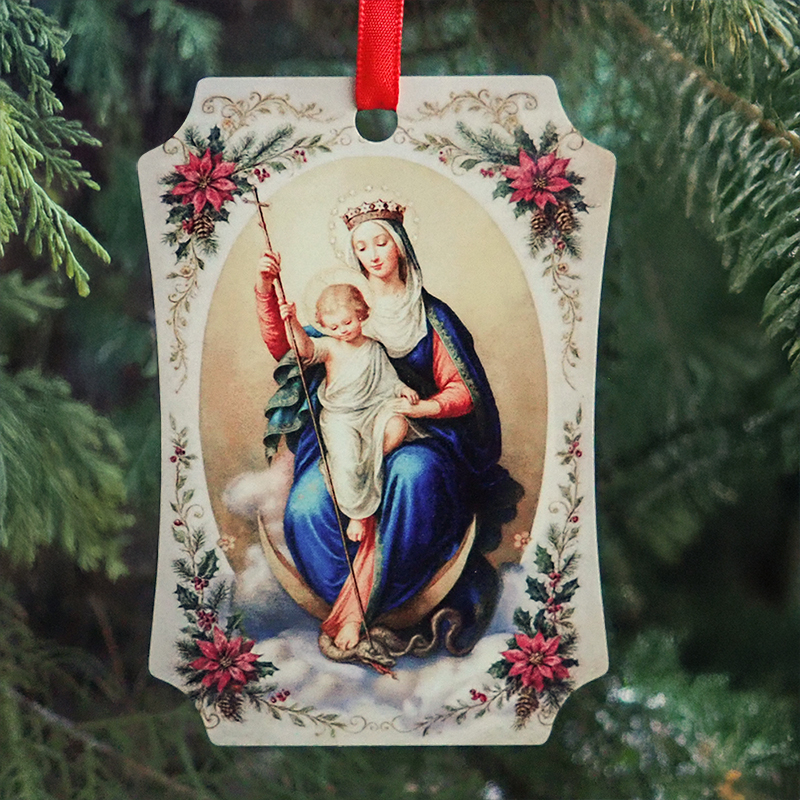
Yet another ornament we are calling our “Christmas Prophecy” ornament. Decorated with an image of Our Blessed Mother and the Child Jesus crushing the head of Satan, the reverse has the words of the Protoevangelium: Genesis 3:15, spoken by God directly after the fall of Adam of Eve. In this precious prophecy, God promises a Redeemer to abolish the curse brought on by our first parents: “I will put enmity between you and the woman, between your seed and her seed; she shall crush your head.”
Rosary Announcement
If you can believe it (we almost cannot), we are already six weeks away from Christmas, which means that we are nearing the deadline for custom rosary orders. If you want a completely custom rosary in time, order soon! Of course we will also have many partially custom rosaries available for faster shipping here and here as we come closer to Christmas.
New Christmas Incense
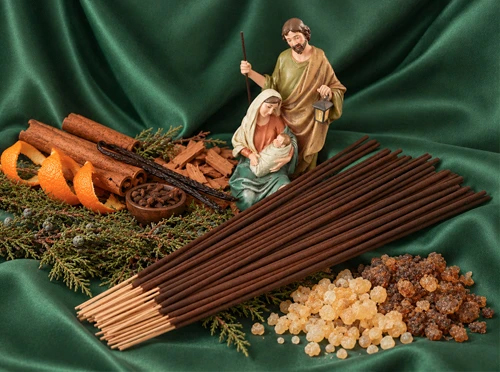
We have added a new Christmas scent to our collection of Incense sticks. This incense is a combination of our other Christmas scents. There is the Divine and mystical scent of frankincense. There is a hint of the stable of Bethlehem in the fir and cedar, and a hint of the Christmas spice that is so reminiscent of Christmas. The name of the scent is simply “Nativity” since it transports us to the stable of Bethlehem with the Holy Family on the Sacred night of the birth of Our Lord.
Also new this year is our “Christmas sampler.” We now have so many Christmas scents – Nativity, Frankincense, Three Kings, Christmas Fir, and Christmas Spice – that we decided to make a single pack with a little bit of each. If you don’t have an absolute favorite, then enjoy a little bit of everything throughout the Christmas season.
For those who have been asking, we are now offering the Frankincense & Myrrh scented candles in the pillar style in addition to our usual tapers. This beautiful scent is a perfect one for the Christmas season.
Christmas Music
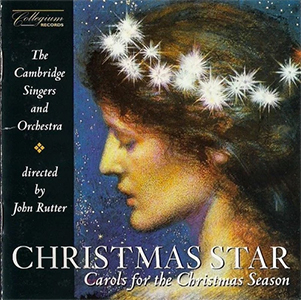
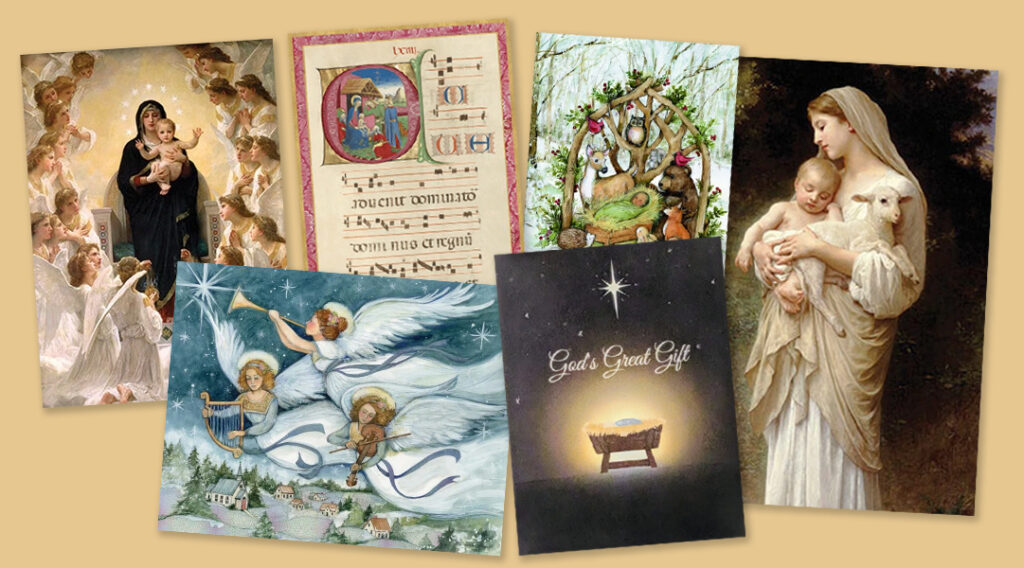
Don’t forget Christmas music for your coming celebration of the Nativity. A few new recordings, especially a recently-released Handel’s Messiah, beautifully performed by the renowned Monteverdi Choir. The King’s Singers and Chanticleer both have new Christmas albums this year – always a treat – as are all of John Rutter’s recordings. Take note of Images of Christ. The liturgical chants of the Christmas season can be found on several of our offerings, as well as the best of Nativity polyphonic pieces. Robert Shaw’s O Magnum Mysterium has been a favorite among our customers – several musical compositions with this wondrous text from the Christmas liturgy:
O great mystery,
and wonderful sacrament,
that animals should see the newborn Lord,
lying in a manger!
O blessed Virgin, whose womb
was worthy to bear
the Lord Jesus Christ.
Alleluia!
Faith of Our Fathers
Written in 1849 by Father Frederick William Faber, this hymn honored the Catholic martyrs in England and Ireland.
Faith of our fathers, living still,
In spite of dungeon, fire and sword.
O, how our hearts beat high with joy,
Whene’er we hear that glorious word.
Faith of our fathers! Holy Faith!
We will be true to thee till death.
Our Fathers, chained in prisons dark,
Were still in heart and conscience free:
How sweet would be their children’s fate,
If they, like them, could die for thee!
Faith of our Fathers! Holy Faith!
We will be true to thee till death.
Faith of our Fathers! Mary’s prayers
Shall win our country back to thee:
And through the truth that comes from God
England shall then indeed be free.
Faith of our Fathers! Holy Faith!
We will be true to thee till death.
Faith of our Fathers! we will love
Both friend and foe in all our strife:
And preach thee too, as love knows how
By kindly words and virtuous life:
Faith of our Fathers! Holy Faith!
We will be true to thee till death.
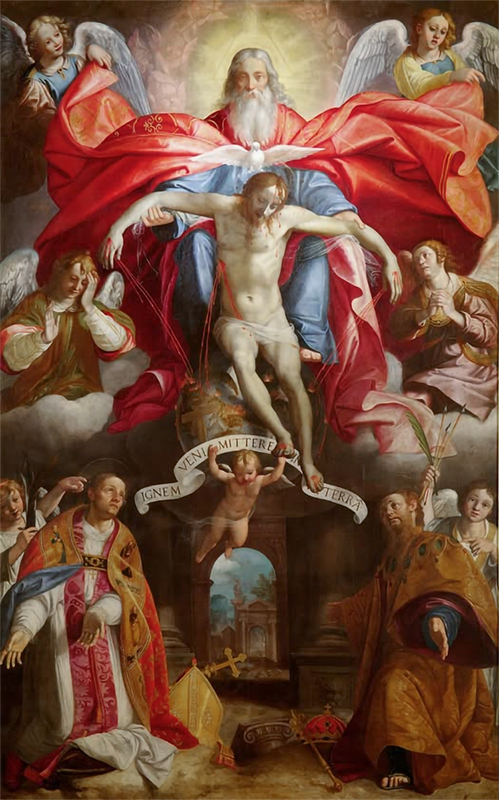
‘The Martyrs’ Picture’, was painted by Durante Alberti in 1583, just after the foundation of the Venerable English College (1579) in Rome, where the picture still hangs today. It depicts the Blessed Trinity with two English martyrs: St Thomas of Canterbury (on the left) and St Edmund, King of East Anglia (on the right). Christ, with outstretched arms is being held by His Father. Blood is pouring out from his wounds and is falling onto a map of the British Isles. A cherub is holding up the College motto: Ignem veni mittere in terram (I have come to bring fire to the earth). According to tradition, students would congregate around this picture to sing the Te Deum whenever news reached the College of the martyrdom of a former student who had been executed for professing the Catholic Faith England in the late 16th century. A total of forty-four of these alumni of the College were martyred – the list includes names such as Robert Southwell and Henry Walpole.