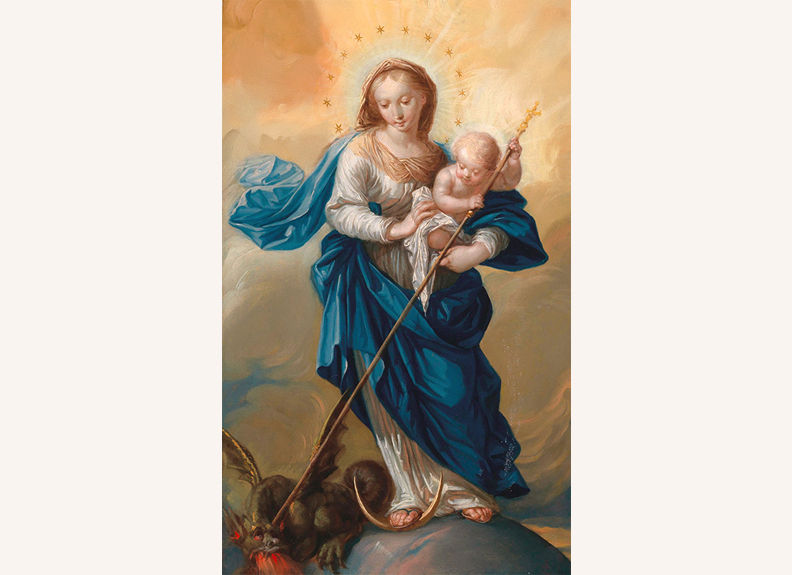
“I am the Immaculate Conception”
“I will put enmity between you and the woman,
between your seed and her seed; she shall crush your head,
and you shall lie in wait for her heel.”
(Genesis 3:15)
Dear Friends of Carmel,
This utterance of God spoken to the serpent in the Garden of Eden after The Fall is called the “Protoevangelium,” the first Gospel: the first and immediate promise of a Savior Who would defeat the evil of Satan and redeem humanity.
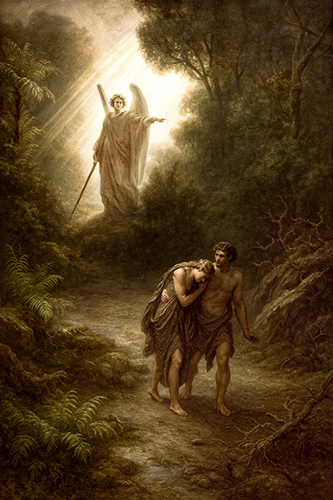
Adam had just committed the first sin – that sin of self-willed, self-ruling disobedience of Almighty God – spurning His grace, surrendering all of His gifts, and earning eternal punishment with Satan and all of the rebellious angels in hell. The Catechism tells us that “On account of the sin of Adam, we, his descendants, come into the world deprived of sanctifying grace and inherit his punishment, as we would have inherited his gifts had he been obedient to God. This sin in us is called original sin.” Adam as head of humanity represented all who would come after him. Thus, in losing God and the privileges granted him (great knowledge, moral integrity, freedom from suffering and death, above all, union with God by sanctifying grace), he forfeited all for all those who would come after him. Alas, we inherit Adam’s sin and penalty at our birth: original sin.
However, God immediately revealed His mercy and gave hope to Adam’s descendants – the promise of a Redeemer. God would fulfill this promise by a parallel: as Adam had fallen through a woman, Eve, so would the New Adam raise up mankind from that sin through a woman, the Virgin Mary.
That woman would be the Redeemer’s Mother – and by our unity with Him, our Mother. As Eve brought us forth in sin, Mary would bring us forth in grace. This immense vocation demanded a holiness unlike that of any other creature. Sin would never be allowed even to touch her. She belonged always completely and irrevocably to God alone. She who would form the very flesh of the perfect God in her womb must herself be perfect, immaculate. In a few days time, on December 8th, we celebrate the Feast of the Immaculate Conception: that dogma which proclaims that the Blessed Virgin Mary, by means of a preservative redemption, in view of Christ’s sacrifice on the Cross, was conceived without original sin. This is indeed a singular grace, granted only to her as the very basis of her vocation to be the Mother of God.
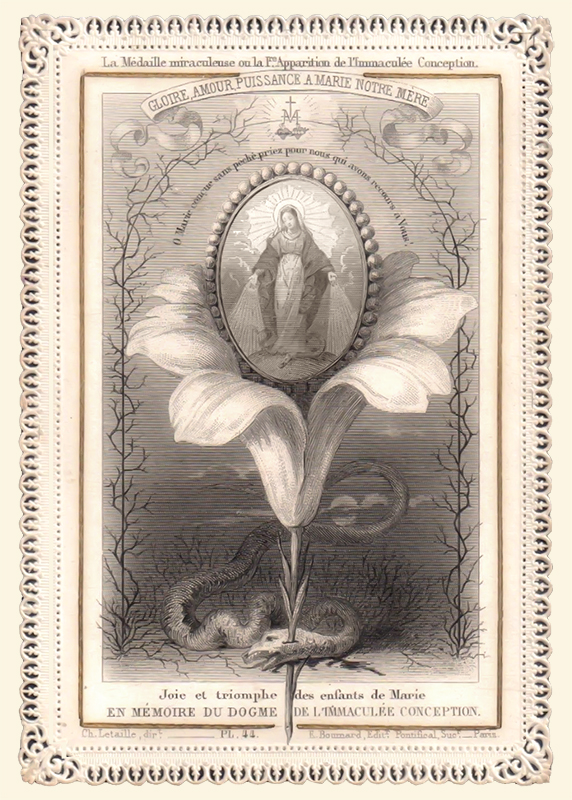
Perhaps most Americans do not know that our country was dedicated to Our Lady under the title of the Immaculate Conception in 1959. The upcoming Feast of the Immaculate Conception is a holy day of obligation world-wide, but we have a special claim to celebrating!
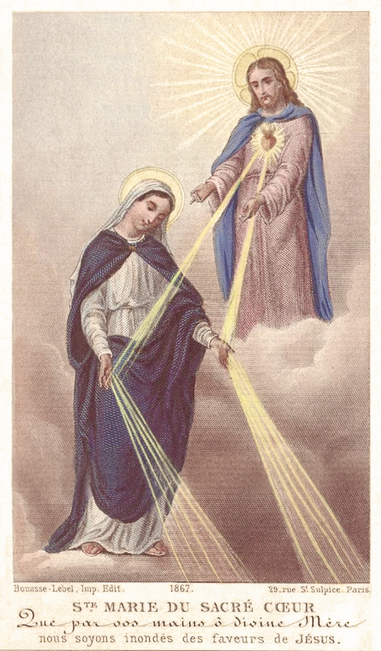
An ideal way to celebrate is to explore the wonders God has done in and through Our Lady – and in particular, to consider this most holy Woman’s vocation as Co-redemptrix and Mediatrix of All Graces. As we share below, you will see we are in good company! More than one Pope has used the occasion of this Feast on December 8th to teach about these very titles. You may have recently seen or read other articles about them, but we feel compelled to give tribute in our own small way. As St. Bernard of Clairvaux wrote: “Of Mary there is never enough!”
On December 8th in the year 1854, Pope Pius IX published the apostolic constitution called Ineffabilis Deus. In this solemn document with the full weight of his authority, he proclaimed the long-believed doctrine of the Immaculate Conception to be a dogma of the Faith; in it, he defined all that it means and traced its history through the Apostolic tradition of the Church.
This encyclical is worth reading in its entirety! But here we share a few excerpts from the end of the document, where he expounds on what this dogma means for the role of the Blessed Mother in salvation history:
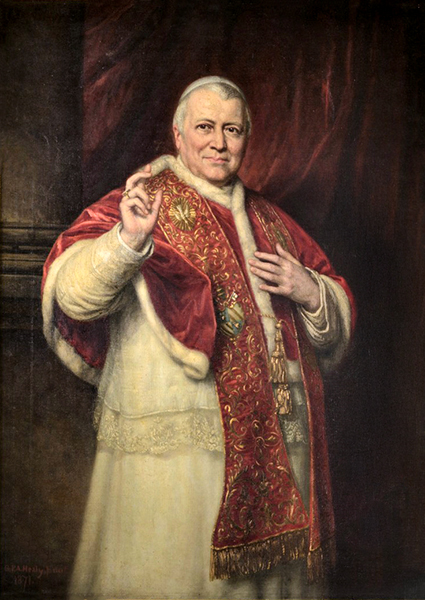
“All our hope do we repose in the most Blessed Virgin — in the all-fair and immaculate one, who has crushed the poisonous head of the most cruel serpent and brought salvation to the world; in her who is the glory of the prophets and apostles, the honor of the martyrs, the crown and joy of all the saints; in her who is the safest refuge and the most trustworthy helper of all who are in danger; in her who, with her only-begotten Son, is the most powerful Mediatrix and Conciliatrix of the whole world; in her who is the most excellent glory, ornament, and impregnable stronghold of the holy Church; in her who has destroyed all heresies and snatched the faithful people and nations from all kinds of direst calamities; in her do we hope, who has delivered us from so many threatening dangers. We have, therefore, a very certain hope and complete confidence that the most Blessed Virgin will ensure by her most powerful patronage that all difficulties be removed and all errors dissipated, so that our Holy Mother the Catholic Church may flourish daily more and more throughout all the nations and countries, and may reign “from sea to sea and from the river to the ends of the earth” and may enjoy genuine peace, tranquility and liberty. We are firm in our confidence that she will obtain pardon for the sinner, health for the sick, strength of heart for the weak, consolation for the afflicted, help for those in danger; that she will remove spiritual blindness from all who are in error, so that they may return to the path of truth and justice, and that here may be one flock and one shepherd.
Let all the children of the Catholic Church, who are so very dear to us, hear these words of ours. With a still more ardent zeal for piety, religion and love, let them continue to venerate, invoke and pray to the most Blessed Virgin Mary, Mother of God, conceived without original sin. Let them fly with utter confidence to this most sweet Mother of mercy and grace in all dangers, difficulties, needs, doubts and fears. Under her guidance, under her patronage, under her kindness and protection, nothing is to be feared; nothing is hopeless. Because, while bearing toward us a truly motherly affection and having in her care the work of our salvation, she is solicitous about the whole human race. And since she has been appointed by God to be the Queen of heaven and earth, and is exalted above all the choirs of angels and saints, and even stands at the right hand of her only-begotten Son, Jesus Christ Our Lord, she presents our petitions in a most efficacious manner. What she asks, she obtains. Her pleas can never be unheard.”
Fifty years later, St. Pope Pius X wrote another encyclical on the Immaculate Conception (Ad Diem Illum Laetissiumum) to commemorate the fiftieth anniversary of the declaration above. Again, we share with you here just an excerpt of what this Pontiff had to say on the topic. It is lengthy – but we cannot bring ourselves further to dissect or abbreviate all that he said in this beautiful explanation of the doctrine (emphasis added):
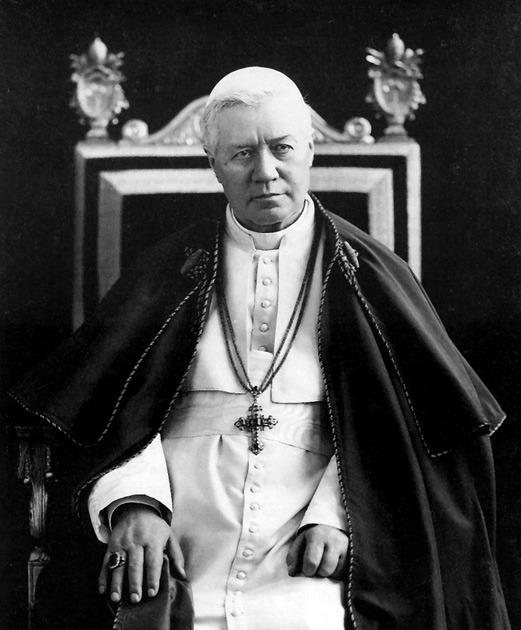
“Could not God have given us, in another way than through the Virgin, the Redeemer of the human race and the Founder of the Faith? But, since Divine Providence has been pleased that we should have the Man-God through Mary, who conceived Him by the Holy Ghost and bore Him in her breast, it only remains for us to receive Christ from the hands of Mary. Hence whenever the Scriptures speak prophetically of the grace which was to appear among us, the Redeemer of mankind is almost invariably presented to us as united with His mother. The Lamb that is to rule the world will be sent – but He will be sent from the rock of the desert; the flower will blossom, but it will blossom from the root of Jesse. Adam, the father of mankind, looked to Mary crushing the serpent’s head, and he dried the tears that the malediction had brought into his eyes…
Moreover it was not only the prerogative of the Most Holy Mother to have furnished the material of His flesh to the Only Son of God, Who was to be born with human members (S. Bede Ven. L. Iv. in Luc. xl.), of which material should be prepared the Victim for the salvation of men; but hers was also the office of tending and nourishing that Victim, and at the appointed time presenting Him for the sacrifice. Hence that uninterrupted community of life and labors of the Son and the Mother, so that of both might have been uttered the words of the Psalmist, “My life is consumed in sorrow and my years in grief” (Ps xxx., 11). When the supreme hour of the Son came, beside the Cross of Jesus there stood Mary His Mother, not merely occupied in contemplating the cruel spectacle, but rejoicing that her Only Son was offered for the salvation of mankind; and she so entirely participated in His Passion, that if it had been possible she would have gladly borne all the torments that her Son bore (S. Bonaventure: 1. Sent d. 48, ad Litt. dub. 4). From this community of will and suffering between Christ and Mary she merited to become most worthily the Reparatrix of the lost world (Eadmeri Mon. De Excellentia Virg. Mariae, c. 9) and Dispensatrix of all the gifts that Our Savior purchased for us by His Death and by His Blood.
It cannot, of course, be denied that the dispensation of these treasures is the particular and peculiar right of Jesus Christ, for they are the exclusive fruit of His Death, who by His nature is the mediator between God and man. Nevertheless, by this companionship in sorrow and suffering already mentioned between the Mother and the Son, it has been allowed to the august Virgin to be the most powerful mediatrix and advocate of the whole world with her Divine Son (Pius IX. Ineffabilis). The source, then, is Jesus Christ “of whose fullness we have all received” (John i., 16), “from whom the whole body, being compacted and fitly joined together by what every joint supplieth, according to the operation in the measure of every part, maketh increase of the body unto the edifying of itself in charity” (Ephesians iv., 16). But Mary, as St. Bernard justly remarks, is the channel (Serm. de temp on the Nativ. B. V. De Aquaeductu n. 4)…
We are then, it will be seen, very far from attributing to the Mother of God a productive power of grace – a power which belongs to God alone. Yet, since Mary carries it over all in holiness and union with Jesus Christ, and has been associated by Jesus Christ in the work of redemption, she merits for us de congruo, in the language of theologians, what Jesus Christ merits for us de condigno, and she is the supreme Minister of the distribution of graces…
… [S]he is, for all these reasons, a most sure and efficacious assistance to us for arriving at the knowledge and love of Jesus Christ. Those, alas! furnish us by their conduct with a peremptory proof of it, who seduced by the wiles of the demon or deceived by false doctrines, think they can do without the help of the Virgin. Hapless are they who neglect Mary under pretext of the honor to be paid to Jesus Christ! As if the Child could be found elsewhere than with the Mother!”
Catholic Marian devotion has been assaulted, distorted and misrepresented for centuries, and we need not be surprised as to why: “I will put enmity between you and the woman, between your seed and her seed.” To separate the children from the Mother, by whatever method, would be a great triumph of the serpent – and make them vulnerable to his deceptions. After the clear, forthright teaching above, it would seem difficult that anyone of goodwill would think that the praise of the Mother detracts from the praise of the Son!
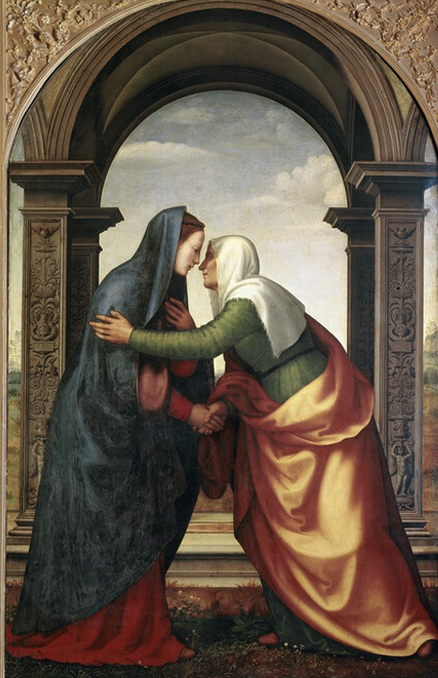
In Holy Scripture, we read that Blessed Mary herself affirmed her role in salvation history. St. Luke’s Gospel (1:40-45) relates that Elizabeth, the mother of St. John the Baptist, by the light of the Holy Spirit, cried out, “Blessed are thou among women” and called her “mother of my Lord” – the first recognition and praise of the Mother of God. She further praised Mary’s exalted vocation: “Blessed are you who have believed, for the things spoken to you by the Lord shall be accomplished.” What was Our Lady’s response to all of this? She did not deny her great privilege with false humility, nor did she rebuke St. Elizabeth’s high praise.
Her words, humble and truthful, acknowledged her own divinely given vocation as a work of God to be glorified: “My soul magnifies the Lord….for He has regarded the lowliness of His handmaid, for behold, from henceforth all generations shall call me blessed.”
In these days of Advent, we offer you these further sources to learn the true Marian doctrine of Holy Church, both for educational and catechetical purposes, and also as wonderful material for meditation and prayer:
- If you missed it in our last newsletter, this sermon given to our community several years ago is a wonderful summary of the doctrine. We received many expressions of gratitude from people who listened to it and profited.
- Excellent summary by Father Reginald Garrigou-Lagrange, renowned theologian
- Divine Office Propers for the Feast of Our Lady Mediatrix of all Graces – In the Carmelite Order it is a second class feast celebrated on July 23rd, the octave of Our Lady of Mount Carmel.
And as we prepare for Christmas, let us be among those whom Our Lady prophesied, and call her Blessed! Let us hasten to the Crib with hearts full of joy and hope in the infallible promise of a Redeemer, the promise that evil and the head of the serpent will be crushed once and for all. Let us remember that we will find that Redeemer in the same place that the Shepherds found Him, in the same place that the Magi found Him, in the same place that Christians of all times have found Him and will continue to find Him until the day of that final victory: in the arms of His Mother.
Our Lady conceived without sin, pray for us who have recourse to thee!
Your Carmelite Sisters
“O Lord Jesus Christ, our Mediator with the Father, you have appointed the most blessed Virgin, your Mother, who is also our mother, as our mediatrix with you. Grant that whoever comes to you seeking blessings, may be given the favors he seeks through her pleading. This we ask of you, Lord Jesus, living and reigning with the same God the Father in the unity of the Holy Spirit, God, forever. Amen.”
– Collect for July 23rd, Feast of Mediatrix of all Graces
*Medal of the Immaculate Conception*
Our Mother in Heaven works tirelessly to lead her children to Jesus Christ, her Divine Son. Throughout the centuries, all Marian sacramentals instituted by Holy Church through Our Lady’s direction and inspiration have this objective. The Rosary, the greatest prayer after the Liturgy, is the prime example of this. Through it, we meditate on the mysteries of Our Lord’s life, and she impresses upon our hearts her own thoughts and sentiments, welcoming us to join our prayer with hers – so that “by meditating on these mysteries we may imitate what they contain and obtain what they promise” (closing prayer). The Brown Scapular is another illustration of her purpose of uniting souls to Christ.
At Guadalupe, she left an image of herself that was such a perfect catechism in pictures and symbols (unbeknownst to the Spanish missionaries in the city at that time) that any Aztec who looked at it could gain a basic understanding of the Christian Faith. Thus, eight million souls converted to the Catholic Church in the space of a few years!
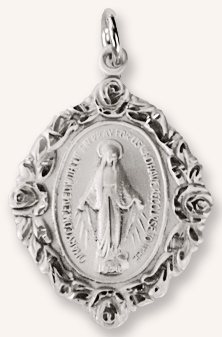
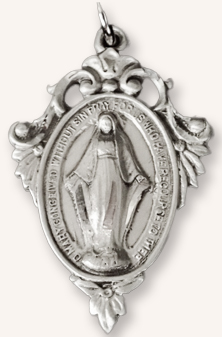
Today we remind you of another such important sacramental, the Medal of the Immaculate Conception. Most people do not know it by this title, but by The Miraculous Medal. So many miracles, so many conversions have been attributed to it that it has become popularly known under this title.
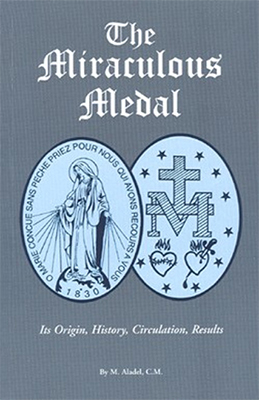
Our Lady herself prescribed each detail of the design – and once again, we see in it a perfect catechism of the Faith. She appeared in a series of apparitions to St. Catherine Laboure, a novice of the Daughters of Charity in France, in the year 1830. The times were dire; France was on the verge of revolution. Our Lady foretold what would happen and predicted great tribulation through the whole world.
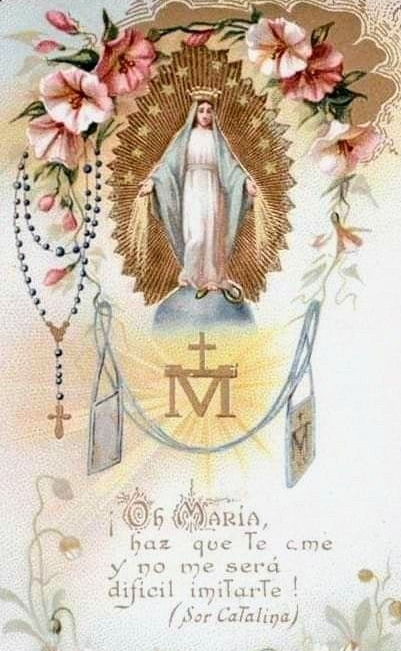
In the final apparition, Saint Catherine saw Our Lady exactly as she appears on the Miraculous Medal, standing on the world, with rays of light emanating from the rings on her fingers. St. Catherine writes:
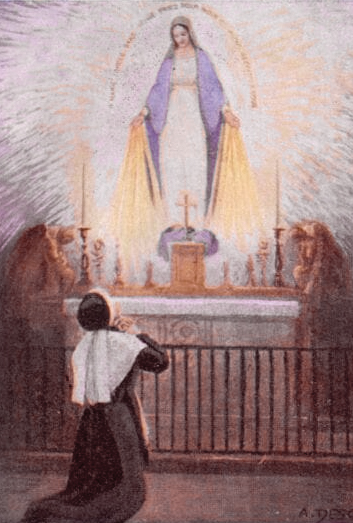
“I would not know how to express the beauty and brilliancy of these rays. And the Blessed Virgin added: ‘Behold the symbol of the graces I shed upon those who ask me for them,’ thus making me understand how generous she is to all who implore her intercession…. How many favors she grants to those who ask. There then formed around the Blessed Virgin a frame slightly oval, upon which appeared, in golden letters these words: ‘O Mary! Conceived without sin, pray for us who have recourse to thee!’ Then I heard a voice which said: ‘Have a medal struck upon this model. Persons who wear it indulgenced, will receive great graces, especially if they wear it around the neck; graces will be abundantly bestowed upon those who have confidence.’ The image then turned, showing on the reverse the M surmounted by the cross with a bar at its base. Beneath this monogram were the hearts of Jesus and Mary, all surrounded by twelve stars.”
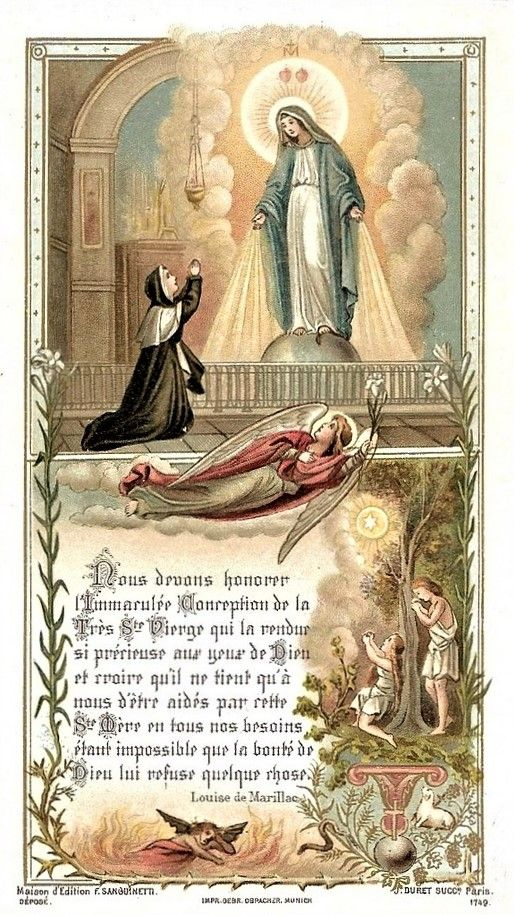
The Miraculous Medal perfectly sums up all that our Popes spoke of in their declarations quoted above. It invokes Our Lady under the title of her Immaculate Conception, the foundation on which rests her mission as Mediatrix of all grace. She stands between Heaven and earth, pouring forth prayers to God – and from Him, graces, through her hands, to souls upon earth. On the reverse of the medal, we see the “M” and cross, interlaced as one. The cross comes from the “M,” Christ comes from Mary – and yet the “M” also hangs and depends upon the cross, as Mary herself depends on the Cross for redemption, just as we do. In the act of redemption, the two Hearts act as one.
As mentioned above, the miracles that came from the propagation were so numerous that it became known simply as the Miraculous Medal. We note that Our Blessed Mother specifically said people should wear it “indulgenced,” and also that it should be “worn about the neck.”
Be sure to have your Miraculous Medals blessed by a priest! It is not a good luck charm, but a sacramental that draws its power and grace from the treasury of the Church. There is also an enrollment ceremony for the Miraculous Medal, as there is for the Brown Scapular, which is performed by the priest, though it is not necessary to be enrolled in order to wear the medal.
Original French Miraculous Medals
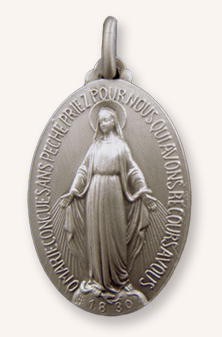
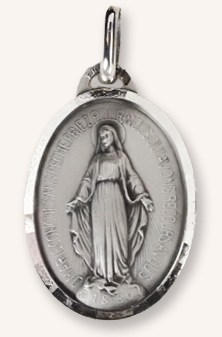
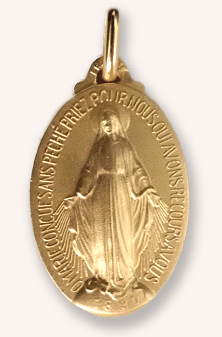
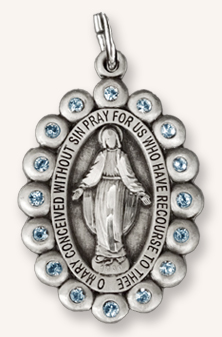
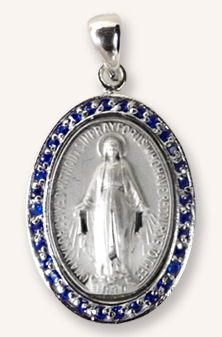
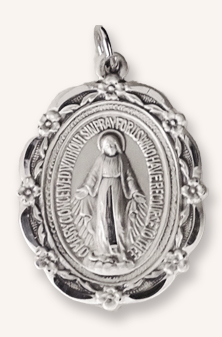
We offer on our website a variety of Miraculous Medals, in a variety of styles, sizes and metal content to suit different tastes and budgets. Our most popular are those we import from France. They are made by one of the original Miraculous Medal manufacturers, who worked directly with Rue de Bac not long after the apparitions in the mid 1800’s. These medals are cast in the exact model of the original, even with the inscription being in French. If you order a medal from us and would like to have it blessed, be sure to mention it in your order comments, and we will be happy to have it blessed by a priest before shipping it to you.
Candlemas Candle Blessing

February 2nd, the Feast of the Purification, closes the Christmas Season, and it is the day designated by the Church for the special blessing of candles. The blessed candle (as we have discussed in a past newsletter) is a powerful sacramental symbol of Our Lord, and it is one of the three great sacramentals of the Church that comes to us directly through the Liturgy, along with blessed palms and blessed ashes. For the past few years we have invited people to have their candles blessed at this special Mass, so that this singular blessing that happens only once in the year might be available to all who desire it. Last year we shipped out not hundreds, but thousands, of blessed candles in the weeks following the Feast! We are now accepting orders for candles that will be shipped after February 2nd, 2026.
These candles are 100% beeswax and locally handcrafted, and we want to make sure we have enough made to fulfill everyone’s request. Please see our instructions page for specific instructions on how to reserve candles for this day, and please see our past newsletter on the Purification for more information about the Feast and the custom of blessing candles.
New Holy Cards
We expanded our collection of holy cards – including many new Christmas styles! They are perfect for slipping into a Christmas card.